

Millions of patients with muscle spasticity are untreated
“In a quality of life survey of people with MS and spasticity, 20% of participants rated their quality of life as worse than death because of their spasticity.”
ref: Hugos CL, Cameron MH. Assessment and Measurement of Spasticity in MS: State of the Evidence. Current Neurology and Neuroscience Reports. 2019;19:79.
ALS patient with severe spasticity
Pathological skeletal muscle hypercontraction occurs when abnormal neural activity drives excessive muscle contraction or when normal relaxation signals fail.
It is a major feature of stroke, brain injury, multiple sclerosis, cerebral palsy, ALS, stiff-person syndrome, epilepsy, essential tremor and Parkinson’s disease.
These sustained contractions cause pain, loss of mobility and independence, and severe physical and social disability.
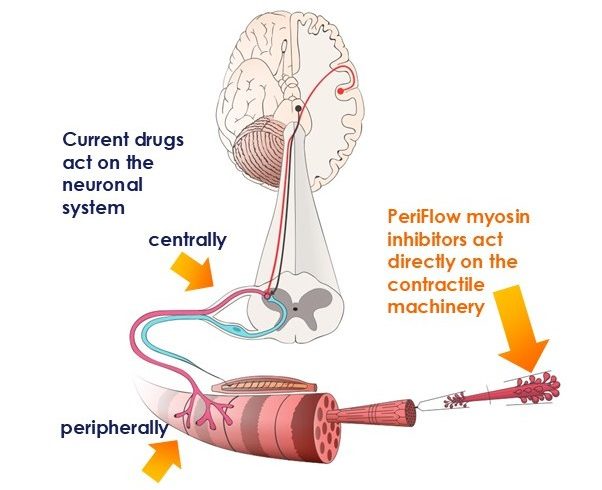
More than 50% of patients discontinue current muscle relaxants because of insufficient efficacy or neurological side effects, leaving millions of people to live with disabling hypercontraction for years or even lifelong without effective treatment.
PeriFlow acts differently: our drugs target the contractile machinery directly, releasing pathological contraction without suppressing the nervous system.
Moderately spastic patient
after stroke
PeriFlow’s skeletal muscle myosin inhibitors fully resolve muscle spasticity without affecting normal physical activity.
Post-stroke rat with spasticity
Same rat after MPH-220 administration
Skeletal muscle myosin inhibitor relaxes muscle spasticity


Contact us
info@periflowtx.com
1 Broadway, 14th floor
Cambridge, MA 02142